The Royal Arch
Its Essence and Philosophical Foundations
If Craft Freemasonry is the foundation, the Royal Arch is the keystone that secures and completes the entire structure.
While in our Lodges we work with the tangible tools of architecture—the square, the compasses and the plumb rule—in Royal Arch Chapters our attention turns inwards. Here, the Companion is guided on a profound spiritual quest. At the heart of the Royal Arch lies the discovery of truth.
The Discovery of Truth:
Where the Master Mason is confronted with loss, the Royal Arch invites him to excavate his own spiritual ruins, bringing to light the buried mysteries of existence.
Origins and Historical Development
The history of the Royal Arch is closely intertwined with the emergence of modern Freemasonry.
Eighteenth-Century Roots: Early references to the Royal Arch date from the mid-eighteenth century, with evidence of its presence in England, Ireland and Scotland during the 1740s. So highly was it prized that the Antients Grand Lodge regarded it as a fourth degree and the very essence of Freemasonry.
The Union of 1813: When the two rival English Grand Lodges united in 1813 to form the United Grand Lodge of England (UGLE), the settlement expressly included the Supreme Order of the Holy Royal Arch within its definition of Pure Antient Masonry. This established its integral place within the English Masonic tradition.
The Allegory of the Temple: In the English Royal Arch tradition, the ritual narrative is set not during the building of King Solomon’s Temple, but centuries later. It concerns the return of the Jewish people from captivity in Babylon and the rebuilding of the Second Temple, under the leadership of Zerubbabel, Joshua and Haggai—the biblical figures represented by the three Principals of the Chapter. During the rebuilding, the workmen’s tools uncover a hidden vault, bringing lost knowledge to light.
The Royal Arch’s relationship with the Bible is fundamental and profound. Its ritual, characters, historical allegory and moral teachings draw directly upon the books of the Old Testament.
While Craft Freemasonry—the first three degrees—draws chiefly upon the Books of Kings and Chronicles, recalling the splendour and construction of Solomon’s First Temple, the Royal Arch leads the seeker into another, equally dramatic biblical setting: destruction, captivity and spiritual renewal.
The Royal Arch and the Bible: Key Connections
1. The Historical and Biblical Setting
The Royal Arch ritual, as exemplified in traditional English workings such as Aldersgate, draws upon the biblical narratives and themes found in Ezra, Nehemiah, Haggai and Daniel.
The Captivity: The narrative begins with the destruction of Jerusalem and Solomon’s Temple by Nebuchadnezzar, and the exile of the Jewish people to Babylon (2 Chronicles 36).
The Decree of Cyrus: Following the biblical period of seventy years, Cyrus, King of Persia, moved by divine inspiration, issues a decree permitting the Jewish people to return to their homeland and rebuild the House of the Lord (Ezra 1).
The Return: The Sojourners return to offer their services in clearing the ground and preparing it for the foundations of the new Temple.
2. The Biblical Figures Who Preside over the Chapter
Unlike a Craft Lodge, which is presided over by a Worshipful Master representing King Solomon, a Royal Arch Chapter in the English tradition is governed by three Principals, representing biblical figures associated with the rebuilding of the Second Temple:
Zerubbabel: The civil governor and Prince of Judah, a descendant of David. In the Chapter, he represents royal authority.
Haggai: The prophet whose impassioned exhortations encourage the people to persevere in rebuilding the Temple despite the difficulties they face (the Book of Haggai). He represents prophetic authority.
Joshua, son of Jehozadak (also called Jeshua): The High Priest who provides spiritual leadership to the people upon their return (Ezra 3). He represents priestly authority.
The Chapter’s two Scribes bear the names of Ezra, the priest and scribe of the Law, and Nehemiah, the governor who rebuilt the walls of Jerusalem.
3. Theology and the Divine Name
The Royal Arch’s deepest connection with the Bible is theological. The central mystery and philosophical culmination of the Order are closely associated with Exodus 3.
When Moses encounters the Burning Bush on Mount Horeb and asks God by what name He should be made known to the Israelites, God replies: “I AM THAT I AM”—in Hebrew, Ehyeh asher ehyeh. In the Greek Septuagint, this is rendered “Ἐγώ εἰμι ὁ ὤν”, meaning “I am the One who is”.
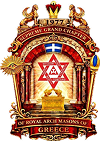
This Greek biblical phrase is the motto surmounting the coat of arms of the Supreme Grand Chapter of Royal Arch Masons of Greece. It emphasises the Order’s God-centred character and its dedication to seeking the truth of the One God.
4. The Allegory of the Vault and the Pickaxe
During the rebuilding, the workmen—the Sojourners—excavate the ruins of Solomon’s former Temple and discover an underground vaulted chamber. Within it stands a plain pedestal, or altar, bearing the sacred inscription associated with the “Lost Word”.
This excavation offers a powerful allegory, both biblical and psychological: each individual is called to dig beneath the “ruins” of the material self to discover the divine spark and the Law of God, handed down from the time of Moses.