
Supreme Grand Chapter of Royal Arch Masons of Greece
The natural culmination and completion of a Master Mason’s journey in Pure Antient Masonry — where the quest for truth truly begins.
ABOUT THE ORDER
What is the Royal Arch?
The Crowning Point of the Masonic Journey
For every Freemason who has attained the degree of Master Mason, the quest for truth does not end; it is only truly beginning. Craft Freemasonry teaches us how to build the temple of our character and lead a virtuous life in society. But what of the deeper questions of existence? What became of that spiritual knowledge symbolically regarded as “lost”?
The answer lies in the Supreme Order of the Holy Royal Arch. As the United Grand Lodge of England (UGLE) has historically declared, Pure Antient Masonry consists of three degrees, including the Holy Royal Arch, which forms an integral and inseparable part of that tradition. It is neither a parallel nor an unrelated system, but the natural culmination and completion of a Master Mason’s journey in Pure Antient Masonry.

THE PURPOSE OF THE ORDER
The Quest for Lost Knowledge
While Craft Freemasonry focuses on building character, the Royal Arch turns our attention inwards, towards the spiritual dimension of our existence.

Rebuilding and Rediscovery
The ritual centres on the return from captivity and the rebuilding of the Second Temple—an allegory of spiritual rebirth.

The Recovery of the Lost Word
Where the Master Mason’s story leaves questions unanswered, the Royal Arch offers further understanding, leading towards the discovery of truth.

Deepening Philosophical Understanding
Through rich symbolism, geometrical allegories—including the Triple Tau—and historical references, the Royal Arch encourages continual reflection and spiritual awareness.
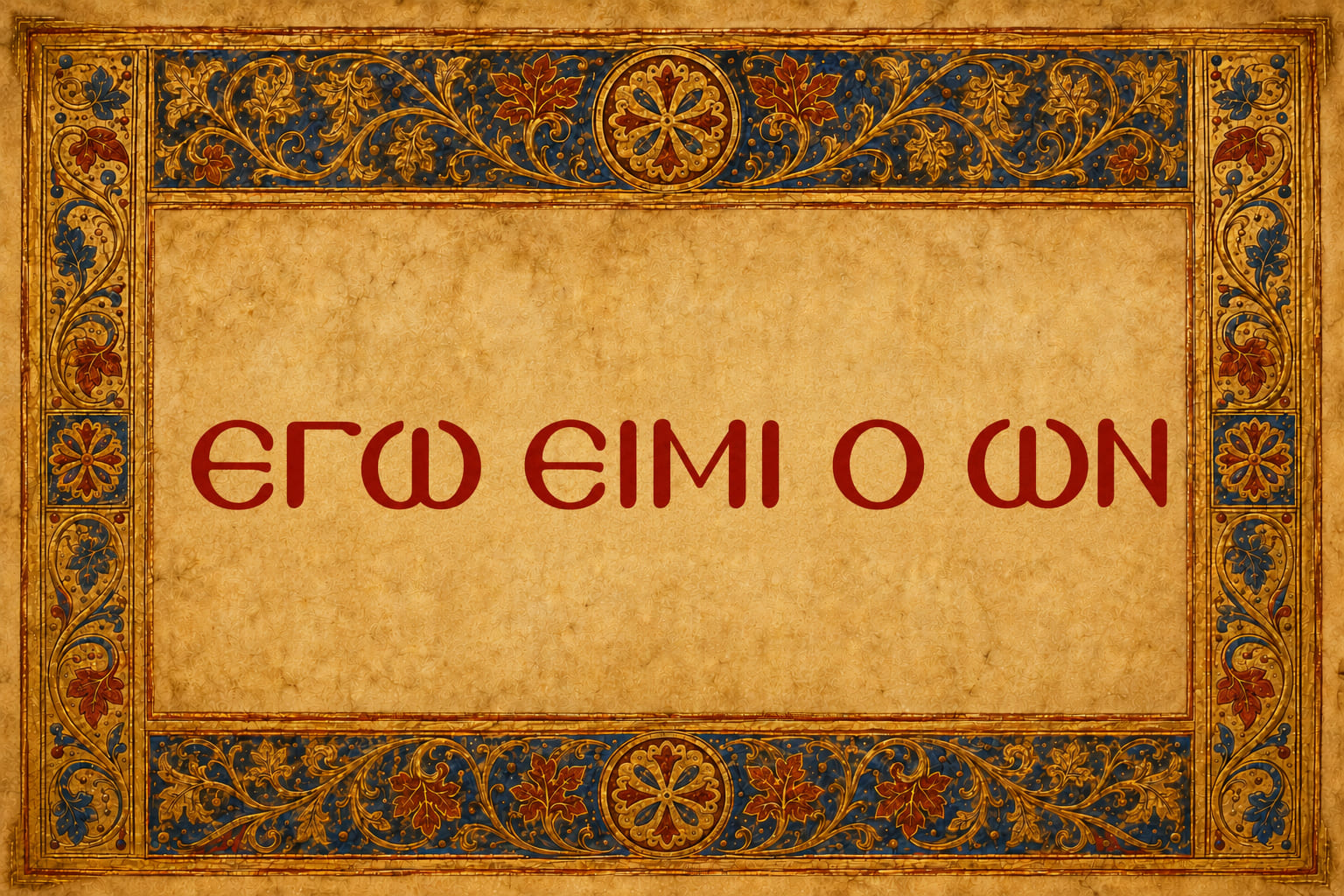
— Exodus, Chapter 3
The Royal Arch does not replace religion or the Bible. Rather, it requires its members to respect the Sacred Law. It draws upon biblical history as a rich tapestry, illustrating how, through adversity—the destruction of the Temple—and persevering labour—its rebuilding—we can always rediscover the Light and return to our spiritual homeland.

The Royal Arch ritual, as exemplified in traditional English workings such as Aldersgate, draws upon the events described in the books of Ezra, Nehemiah, Haggai and Daniel:
The Captivity: The narrative begins with the destruction of Jerusalem and Solomon’s Temple by Nebuchadnezzar, and the exile of the Jewish people to Babylon (2 Chronicles 36).
The Decree of Cyrus: After seventy years, Cyrus, King of Persia, moved by divine inspiration, issues a decree permitting the Jewish people to return to their homeland and rebuild the Temple of the Lord (Ezra 1).
The Return: The “strangers”, or “Sojourners”, return to offer their services in excavating and preparing the ground for the new foundations.
Unlike a Craft Lodge, which is presided over by a Worshipful Master representing King Solomon, a Royal Arch Chapter in the English tradition is governed by three Principals, representing biblical figures associated with the rebuilding of the Second Temple:
Zerubbabel: The civil governor and Prince of Judah, a descendant of David. In the Chapter, he represents sovereign or royal authority.
Haggai: The prophet whose impassioned exhortations encouraged the people to persevere in rebuilding the Temple despite the difficulties they faced (the Book of Haggai). He represents prophetic authority.
Joshua, son of Jehozadak (also called Jeshua): The High Priest who provides spiritual leadership to the people upon their return (Ezra 3). He represents priestly authority.
The Chapter’s two Scribes bear the names of Ezra, the priest and scribe of the Law, and Nehemiah, the governor who rebuilt the walls of Jerusalem.
The Royal Arch’s deepest connection with the Bible is theological. The central mystery and philosophical culmination of the Order are directly connected with Exodus 3.
When Moses encounters the Burning Bush on Mount Horeb and asks God His name, so that he may make it known to the Israelites, God replies: “I AM WHO I AM.”
The Hebrew phrase, Ehyeh asher ehyeh, is rendered in the Greek Septuagint as “Ἐγώ εἰμι ὁ ὤν”—“I am the One who is”. This biblical phrase forms the crowning motto above the coat of arms of the Supreme Grand Chapter, emphasising the Royal Arch’s God-centred character and its dedication to seeking the truth of the One God.
During the rebuilding, the workmen—the Sojourners—excavate the ruins of Solomon’s former Temple and discover an underground vaulted chamber. Within it stands a plain pedestal, or altar, upon which the “Lost Word” is inscribed.
This excavation offers a powerful biblical and psychological allegory: each individual is called to dig beneath the “ruins” of the material self to discover the divine spark and the Law of God, handed down from the time of Moses.
WHY JOIN?
If you feel ready to take the next step towards greater maturity in your Masonic journey, the Royal Arch awaits you.

To Complete Your Masonic Journey
Without the Royal Arch, the Master Mason’s story remains incomplete.
To Experience a Unique Tradition
Royal Arch Chapters offer a setting of exceptional beauty and rich symbolism. From the crimson and blue aprons to the gold jewels and the Triple Tau—the emblem of the Order—every detail conveys a sense of understated splendour and dignified solemnity.
To Strengthen Your Fraternal Bonds
Membership of a Chapter under the Supreme Grand Chapter of Royal Arch Masons of Greece connects you with an international fellowship spanning recognised jurisdictions worldwide, fostering spiritual affinity with distinguished Companions in Greece and abroad.
GOVERNANCE & STRUCTURE
The Governance of the Order
The Order is governed by a collective body, the Supreme Grand Chapter, in which all Chapters are represented, under the leadership of the Three Grand Principals.
Grand Officers from May 2026
- First Grand Principal
M.E. Comp. Spyridon Doukas

- Second Grand Principal
M.E. Comp. Alexandros – Ioannis Basis

- Third Grand Principal
M.E. Comp. Dimitrios Skiadopoulos
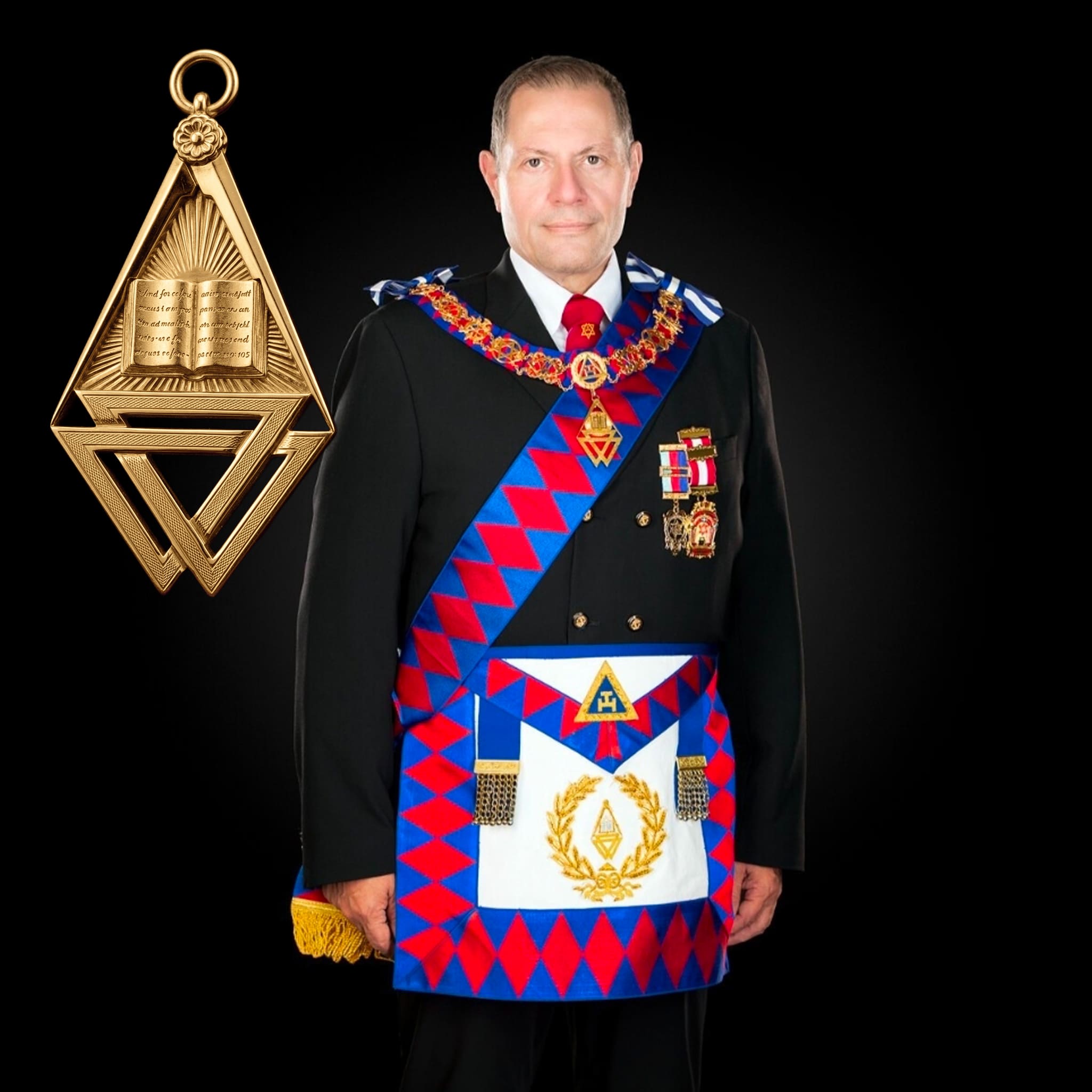
Officer Responsible for External Relations
Rank and Precedence of Members — Organisation & Administration
The members of Grand Chapter rank in the following order:
1. First Grand Principal.
2. Past First Grand Principals.
3. Second Grand Principal.
4. Past Second Grand Principals.
5. Third Grand Principal.
6. Past Third Grand Principals.
7. Grand Superintendents.
8. Past Grand Superintendents.
9. President of the Committee of General Purposes.
10. Past Presidents of the Committee of General Purposes.
11. Grand Registrar.
12. Past Grand Registrars.
13. Grand Scribe E.
14. Grand Scribe N.
15. Past Grand Scribes E.
16. Past Grand Scribes N.
17. Grand Treasurer.
18. Past Grand Treasurers.
19. Grand Director of Ceremonies.
20. Past Grand Directors of Ceremonies.
21. Grand Sword Bearer.
22. Past Grand Sword Bearers.
23. Grand Inspectors.
24. Past Grand Inspectors.
25. Deputy Grand Scribe E.
26. Past Deputy Grand Scribes E.
27. Deputy Grand Director of Ceremonies.
28. Past Deputy Grand Directors of Ceremonies.
29. Principal Grand Sojourner.
30. First Assistant Grand Sojourner.
31. Second Assistant Grand Sojourner.
32. Past Principal Grand Sojourners.
33. Past Assistant Grand Sojourners.
34. Grand Standard Bearer.
35. Past Grand Standard Bearers.
36. Assistant Grand Director of Ceremonies.
37. Past Assistant Grand Directors of Ceremonies.
38. Grand Janitor.
39. Past Grand Janitors.
40. The three Principals of each Chapter.
41. Past First Principals of each Chapter who qualify under Rule 5.
Heads of the Order from 1977 to the Present
| 1977 | Grand High Priest | M.E. Comp. William – Eumenes Kaloudis |
| 1978 | Grand High Priest | M.E. Comp. William – Eumenes Kaloudis |
| 1979 | Grand High Priest | M.E. Comp. William – Eumenes Kaloudis |
| 1980 | Grand High Priest | M.E. Comp. William – Eumenes Kaloudis |
| 1981 | Grand High Priest | M.E. Comp. William – Eumenes Kaloudis |
| 1982 | Grand High Priest | M.E. Comp. William – Eumenes Kaloudis |
| 1983 | Grand High Priest | M.E. Comp. Efstathios Liakopoulos |
| 1984 | Grand High Priest | M.E. Comp. Efstathios Liakopoulos |
| 1985 | Grand High Priest | M.E. Comp. Efstathios Liakopoulos |
| 1986 | Grand High Priest | M.E. Comp. Stefanos Paipetis |
| 1987 | Grand High Priest | M.E. Comp. Stefanos Paipetis |
| 1988 | Grand High Priest | M.E. Comp. Stefanos Paipetis |
| 1989 | Grand High Priest | M.E. Comp. Stefanos Paipetis |
| 1990 | Grand High Priest | M.E. Comp. George Vassiliou |
| 1991 | Grand High Priest | M.E. Comp. Orpheus – George Manos |
| 1992 | Grand High Priest | M.E. Comp. Orpheus – George Manos |

| 1993 | First Grand Principal | M.E. Comp. Leonidas Logothetis |
| 1994 | First Grand Principal | M.E. Comp. Leonidas Logothetis |
| 1995 | First Grand Principal | M.E. Comp. Orpheus – George Manos |
| 1996 | First Grand Principal | M.E. Comp. Orpheus – George Manos |
| 1997 | First Grand Principal | M.E. Comp. Paul Kyriakongonas |
| 1998 | First Grand Principal | M.E. Comp. Paul Kyriakongonas |
| 1999 | First Grand Principal | M.E. Comp. Paul Kyriakongonas |
| 2000 | First Grand Principal | M.E. Comp. George Kaminaris |
| 2001 | First Grand Principal | M.E. Comp. George Kaminaris |
| 2002 | First Grand Principal | M.E. Comp. George Kaminaris |
| 2003 | First Grand Principal | M.E. Comp. George Kaminaris |
| 2004 | First Grand Principal | M.E. Comp. Hermes Ioannides |
| 2005 | First Grand Principal | M.E. Comp. Hermes Ioannides |
| 2006 | First Grand Principal | M.E. Comp. Dimitrios Kontesis |
| 2007 | First Grand Principal | M.E. Comp. Dimitrios Kontesis |
| 2008 | First Grand Principal | M.E. Comp. Dimitrios Kontesis |
| 2009 | First Grand Principal | M.E. Comp. Dimitrios Kontesis |
| 2010 – 2011 | First Grand Principal | M.E. Comp. Dimitrios Mamas |
| 2011 – 2014 | First Grand Principal | M.E. Comp. Ioustinianos Korvesis |
| 2014 – 2018 | First Grand Principal | M.E. Comp. Stylianos Fasoulas |
| 2018 – 2024 | First Grand Principal | M.E. Comp. Georgios Deligiorgis |
| 2024 – 16 May 2026 | First Grand Principal | M.E. Comp. Ioannis Mpenetatos |

| 16 May 2026 – present | First Grand Principal | M.E. Comp. Spyridon Doukas |
A Historic Administrative Reform — Looking to the Future
As First Grand Principal, Ioannis Mpenetatos brought a longstanding discussion to a successful conclusion. He proposed the administrative separation of the Supreme Grand Chapter of Royal Arch Masons of Greece, a proposal approved by the Grand Convocation, with the aim of supporting the institution’s development and strengthening its administrative autonomy.

TRANSITIONAL PROVISION TO THIS RULE
Companions who, before 17 December 2005, held the rank of Deputy Grand Registrar or Past Deputy Grand Registrar shall retain their respective places in the order of precedence, in the order stated, immediately after Past Grand Inspectors and immediately before Deputy Grand Scribes E.
Companions who, before 17 December 2005, held the rank of Deputy Grand Sword Bearer or Past Deputy Grand Sword Bearer shall retain their respective places in the order of precedence, in the order stated, immediately after Past Deputy Grand Directors of Ceremonies and immediately before Principal Grand Sojourners.
Companions who, before 17 December 2005, held the rank of Assistant Grand Scribe E or Past Assistant Grand Scribe E shall retain their respective places in the order of precedence, in the order stated, immediately after Past Grand Treasurers and immediately before Grand Standard Bearers.
Companions who, before 17 December 2005, held the rank of Grand Organist or Past Grand Organist shall retain their respective places in the order of precedence, in the order stated, immediately after Past Grand Standard Bearers and immediately before Assistant Grand Directors of Ceremonies.
To ensure the efficient administration of the Order, its work is supported by the Committee of General Purposes, which oversees its finances and considers petitions for Warrants authorising the formation of new Chapters.
The COMMITTEE OF GENERAL PURPOSES is constituted under Rule 75.
The Committee shall consist of the Grand Principals (including the Pro First Grand Principal, if any), a President, the Grand Registrar, the Grand Scribes Ezra and Nehemiah, the Grand Director of Ceremonies, the Grand Treasurer, the Provincial Grand Superintendents and four other members. The President and one of the four other members shall be appointed by the First Grand Principal. One member shall be elected by Grand Chapter at each Annual Convocation. One-third of the three elected members shall retire each year at the close of the Annual Convocation. Each retiring member shall be eligible for re-election on two occasions only. Each elected term of office shall be three years. Upon retiring for the third time, a member shall not be eligible for re-election until one year has elapsed. Appointed members, other than the President, shall likewise serve for no more than nine years and shall thereafter be ineligible for reappointment until one year has elapsed.
Supreme Grand Chapter
Provinces / Chapters
Provincial Grand Chapter of Attica and the Aegean Islands
Chapters:
Parthenon Chapter No. 3
Miaoulis Chapter No. 4
Pistis Chapter No. 5
Iliotropio Chapter No. 8
Irakleitos Chapter No. 10
Empedoklis Chapter No. 15
Filiki Etaireia Chapter No. 24
Chryseon Koas Chapter No. 54
Omiros Chapter No. 59
Ellinoglosson Xenodocheio Chapter No. 67
Pavlos Melas Chapter No. 76
Apollonios o Rodios Chapter No. 80
Logos Chapter No. 89
Evropi Chapter No. 108
ISIS Research Chapter No. 9 — By special resolution of the Committee of General Purposes, approved by Grand Convocation, this Chapter confers the degree of EXCELLENT MASTER.
Provincial Grand Chapter of Western Greece and the Ionian Islands
Chapters:
Foinix Kerkyras Chapter
Palaion Patron Germanos Chapter No. 1
Enosis Lefkados Chapter No. 16
Beneficenza–Agathoergia Chapter No. 53
Dionysios Romas Chapter No. 84
Filogeneia Chapter No. 93
Alexandros Romas Chapter No. 102
Provincial Grand Chapter of Central and Northern Greece
Chapters:
Megas Alexandros Chapter No. 26
Kassandros Chapter No. 29
Thessaloniki Chapter No. 30
Dimitra Chapter No. 60
Enosis Chapter No. 55 meets in Nicosia, Cyprus, and falls directly under the jurisdiction of the Supreme Grand Chapter.
Total number of Chapters under the Supreme Grand Chapter: 27
HISTORY & TRADITION
Emblem, History & Masonic Regalia
The history of the Royal Arch is closely intertwined with the emergence of modern Freemasonry.
c. 1740
Early recorded references in England, Ireland and Scotland.
Eighteenth-Century Roots: The earliest recorded references to the degree date from the mid-eighteenth century, around 1740, in England, Ireland and Scotland. So highly prized and widely esteemed was the Royal Arch that the Antients Grand Lodge regarded it as the “fourth degree” and the very soul of Freemasonry.
1813
Formal inclusion of the Royal Arch within the definition of Pure Antient Masonry.
The Union of 1813: When the two rival English Grand Lodges united in 1813 to form the United Grand Lodge of England (UGLE), the settlement expressly included the Supreme Order of the Holy Royal Arch within its definition of Pure Antient Masonry, affirming its integral place within the English Masonic tradition.
1976
The beginnings of the Holy Royal Arch in Greece date to March 1976 and formed part of a wider endeavour to bring Greek Freemasonry into closer alignment with established Masonic traditions. A group of distinguished and dedicated Master Masons, seeking to align Greek Freemasonry fully with the ancient traditions and requirements of the Old Charges, resolved to practise the York Rite. These Brethren successively received the degrees of Mark Master, Past Master, Most Excellent Master and, finally, Royal Arch.
The proceedings were conducted by a delegation of York Rite Grand Officers, led by Most Excellent Companion William–Eumenes Kaloudis, then Grand High Priest of the Supreme Grand Chapter of Germany. Under the auspices and guidance of the German body, the Greek Companions proceeded to establish the first three Chapters: two in Athens and one in Piraeus. These Chapters provided the foundation for the regular working of the York Rite degrees, enabling numerous Greek Brethren to be exalted to the supreme degree of the Holy Royal Arch, having first received the degrees of Mark Master, Past Master and Most Excellent Master.
1977
The rapid consolidation of this work led to a decisive institutional step on 7 June 1977. The three founding Chapters—Olympia No. 29, Athina No. 30 and Aegeus No. 32—which had until then operated under the jurisdiction of the German York Rite Grand Chapter, submitted a formal petition for the establishment of an independent national body: the Grand Chapter of Royal Arch Masons of Greece, now known as the Supreme Grand Chapter of Royal Arch Masons of Greece.
The petition was favourably received, and the formal constitution of the new body took place in Athens on 27 November 1977, with due Masonic solemnity. The proceedings were presided over by M.E. Comp. Gordon Merrick, General Grand High Priest of the General Grand Chapter, International, in the presence of M.E. Comp. Guenter Kerres, Grand High Priest of Germany, and numerous other Grand Officers. At this historic meeting, M.E. Comp. William–Eumenes Kaloudis was installed as the first Grand High Priest of Greece. This event crowned the endeavour to establish a regular, internationally recognised Masonic body in Greece through which Brethren could progress in degrees beyond the Craft.
1993
The most decisive turning point in the Order’s modern history in Greece came in March 1993. The General Assembly of the Grand Chapter of Greece of the York Rite resolved to transfer responsibility for the Holy Royal Arch to the Craft, regarding it as an integral part of Pure Antient Masonry. The Companions formed Chapters according to antient usage, adopting the Aldersgate Ritual.
The Order of the Holy Royal Arch thereafter came under the governance of the Supreme Grand Chapter of Royal Arch Masons of Greece, with its own Book of General Regulations and Constitution. From that time onwards, admission to exaltation as a Royal Arch Mason required a Brother to be a Master Mason in good standing and a member of a regular Grand Lodge.
As an institutional consequence of this restructuring, the former Chapters were converted into Mark Lodges, establishing the Grand Lodge of Mark Master Masons of Greece and its Lodges Abroad. This new body, with its own Rules and independent administration and structure, was formally constituted in October 1993 by the Grand Lodge of Mark Master Masons of England and Wales and its Districts and Lodges Overseas, under the presidency of the then Pro Grand Master, M.W. Bro. Lord Swansea.
March 1993
Emblem and Coat of Arms
The design follows the description of the coat of arms of the National Grand Lodge of Greece.
May 2026
Redesigned Emblem and Coat of Arms
The Coat of Arms of the Supreme Grand Chapter of Royal Arch Masons of Greece: An Initiatory and Architectural Interpretation
The emblem depicted in these arms serves as a sacred map of the Mason’s spiritual ascent and a visual embodiment of the ideals of the Holy Royal Arch. Each architectural and symbolic element forms a link in the quest for the Lost Word, together creating a coherent system of allegorical instruction.
Historical Development and Continuity of Meaning
This new emblem represents more than a visual redesign. It is a deliberate statement of historical continuity, skilfully bringing together the principal elements of the Order’s two earlier emblems, dating from 1977 and 1993. At the heart of the composition, bathed in light, the Hexagram enclosing the Triple Tau—Templum Hierosolymae—is restored to a position of prominence. This choice connects the present with the original founding emblem, in which the Triple Tau occupied a central position, while the year 1977 is prominently displayed. At the same time, the predominantly red colouring and architectural structure of the 1993 emblem are retained. That earlier design was modelled on the coat of arms of the National Grand Lodge of Greece. The present emblem thus represents the culmination of the Grand Chapter’s evolving historical identity.
The Royal Arch, the Keystone of Identity and the Holy of Holies
The centre of the emblem is arranged geometrically around the majestic Arch. In the Anglo-American and Irish Masonic traditions, the Arch rests upon sturdy columns and is held securely together by its central keystone. In this emblem, the keystone prominently bears the Greek flag, making it the defining symbol of national identity. It unequivocally declares the national jurisdiction of the Supreme Grand Chapter and affirms the harmonious connection between Greek Freemasonry and the worldwide fraternity. Passing beneath the Arch symbolises the descent into the ruins of the First Temple and entry into the abandoned Holy of Holies—the Sanctum Sanctorum—where the highest mysteries are discovered through diligent enquiry.
The Meaning of “Supreme” and the Allegorical Figures of Historical Continuity
The designation “Supreme” in the title Supreme Grand Chapter is understood here as more than an administrative distinction: it also carries a spiritual significance rooted in the Royal Arch ritual itself. In the British tradition, particularly in the established English Aldersgate working, Royal Arch proceedings are dedicated to the glory of the “True and Living God Most High”. Within this interpretation, that direct reference to the Divine gives deeper meaning to the designation, associating the Order with the Supreme Being.
The two allegorical figures standing on either side, between and behind the columns, may be understood in the same light. Their presence in the new coat of arms directly serves the purpose of historical continuity, recalling prominent features of the emblem used from 1993 to 2026. Although rendered more abstractly in the modern design, their retention invites the Companion to explore the Order’s history and discover their full symbolic meaning. The figure on the left, which held a sword in the historical emblem, symbolises Justice. The figure on the right, traditionally bearing the cornucopia—the horn of Amalthea—embodies Mercy. Their continuing presence, linking past and present, reminds us that unwavering Justice must always be tempered by understanding, reflecting the Creator’s supreme Mercy towards His creation.
The Sceptres of the Three Grand Principals
Following established international tradition, the coat of arms prominently displays the emblems of authority of the Three Grand Principals—Zerubbabel, Haggai and Joshua—supporting the spiritual structure beyond the columns:
1. The Crown — Top Centre: Crowning the composition, it represents the sceptre of the First Grand Principal, the King. It symbolises imperial dignity and the capacity for wise governance.
2. The All-Seeing Eye — Left-Hand Sceptre: Surmounting the sceptre of the Second Grand Principal, the Prophet, it embodies ceaseless spiritual vigilance and the omnipresence of the Supreme Being within the place of labour.
3. The Sacred Stone / Mitre — Right-Hand Sceptre: Representing the sceptre of the Third Grand Principal, the High Priest, it appears as a priestly emblem of reverence, symbolising omniscience and devotion to the Sacred Law.
The Ark of the Covenant and the Sphinxes
At the base of the composition, beyond the ascending steps that signify spiritual endeavour, rests the golden Ark of the Covenant, overshadowed by the wings of the Cherubim. It represents the repository of sacred tradition and the ultimate object of the search within the Holy of Holies. Above, on either side of the Crown, two golden Sphinxes stand watch. As timeless guardians of the ancient mysteries, they protect the structure and flank the year 1977, perpetually commemorating the foundation of the Grand Chapter in Greece.
Patents
1977
1993

1986 – Royal Arch Mason

1986 – Excellent Master

Agreements of Mutual Recognition

Grand Representative’s Patent

Warrant
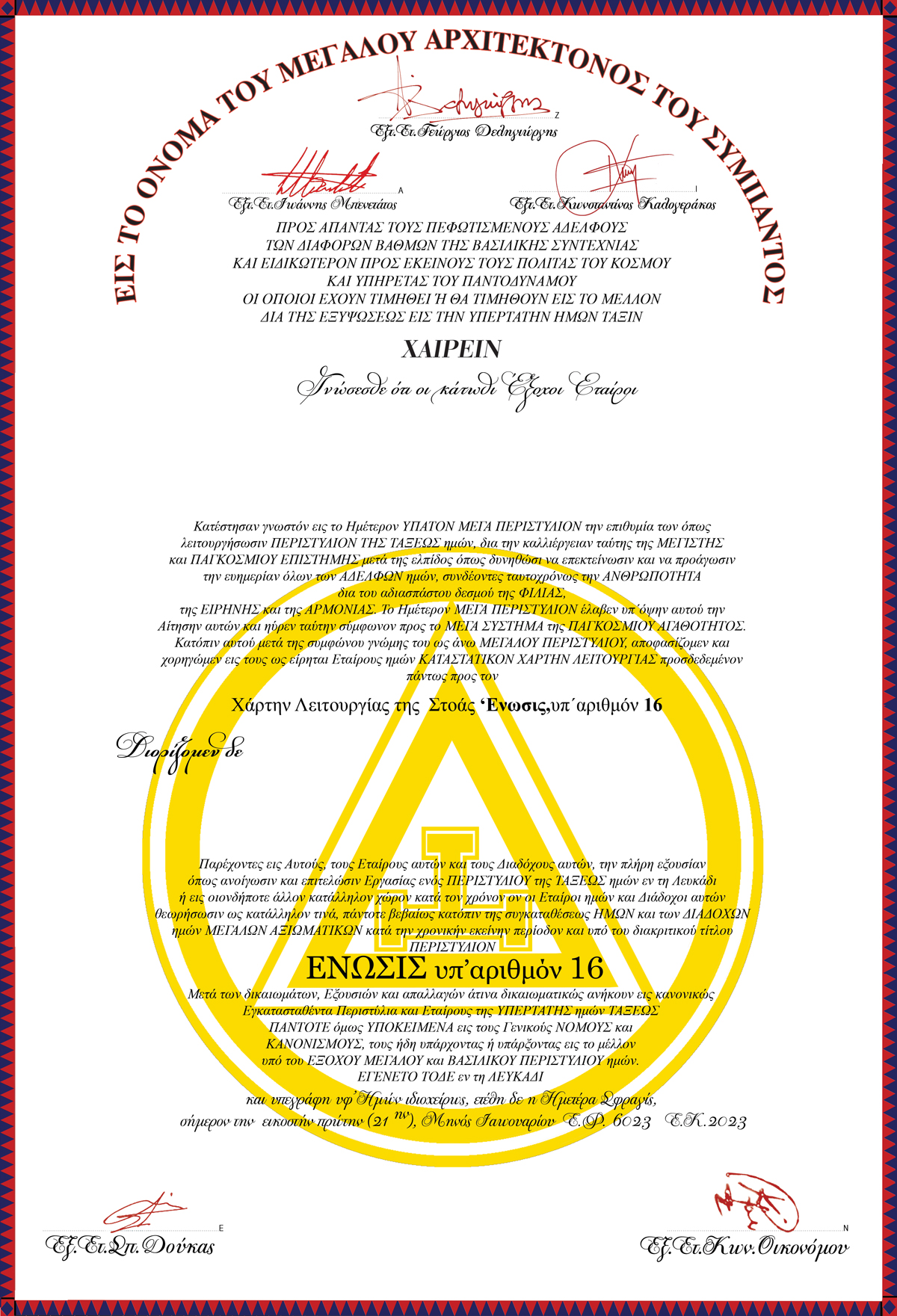
Grand Officer’s Patent

Grand Representatives of Overseas Supreme Grand Royal Arch Chapters
Supreme Grand Royal Arch Chapter of Ireland

Masonic Regalia

The Apron – The apron is made of white lambskin, with an indented border of crimson and blue and a distinctive triangular flap bearing the gold-embroidered emblem of the Triple Tau. Principals and Past Principals wear a crimson silk triangle with corresponding ribbons.
The deep red or crimson colouring of the Holy Royal Arch apron is among the Order’s oldest distinguishing features. As early as 12 June 1765, the minutes prescribed a white leather apron bordered with an indented crimson ribbon. In 1807, a border combining two colours, red and purple, was introduced. Blue is therefore far from absent from the Royal Arch. Together with purple and crimson, it forms part of the Order’s historic palette. Red nevertheless emerged as the distinctive colour of the Chapter, in contrast to the blue already associated with the three degrees of Craft Freemasonry. An illustrative example from the closing decades of the eighteenth century depicts the Craft Mason in blue clothing and the Royal Arch Mason in red clothing, wearing an apron edged with red ribbon. Later Masonic interpretation associated scarlet or crimson with “fervency and zeal”: the spiritual energy and dedication required in the search for the lost Light. The combination of blue, purple and scarlet also recalls the richly coloured sacred textiles of the Tabernacle and the Temple. Scientific research into ancient dyes has identified biblical scarlet as a valuable organic dye derived from scale insects and rich in kermesic acid. This supports the understanding that deep red was a rare and prestigious colour in antiquity, appropriate for priestly garments and sacred textiles. The interpretation most securely grounded in the evidence is therefore that crimson became established historically as the distinctive colour of the Royal Arch and, through a long Masonic tradition, acquired associations with fervency, zeal, sacredness and spiritual rebirth.
A crucial distinction is that the Royal Arch apron is not simply red instead of blue. Modern English tradition recognises purple, crimson and light blue as its colours, although dark blue has in practice replaced purple in the manufacture of certain items of regalia. The modern apron border combines red and blue.
Principal Sources
Christopher Powell, “Thoughts on the Early History of the Royal Arch in England”, Ars Quatuor Coronatorum, vol. 138 — a modern scholarly study of the early minutes and documentary evidence.
A. R. Hewitt, “Early Royal Arch Regalia”, an address delivered before Supreme Grand Chapter on 9 February 1972 — a detailed account of the development of the apron from 1765 onwards.
William Harvey, The Story of the Royal Arch (1919) — a historical Masonic interpretation of scarlet as a symbol of “fervency and zeal”, and of the relationship between blue, scarlet and purple.
Zohar Amar et al., “The Scarlet Dye of the Holy Land”, BioScience, vol. 55 (2005) — a scientific study of biblical scarlet dye and kermesic acid.
General Regulations of the Supreme Grand Chapter of England, 2026 edition, Regulation 85 — the official specification of the colours of modern Royal Arch regalia.
The Sash – The sash is worn over the left shoulder and terminates in a fringe: silk for Companions, and gold or gilt for serving Principals and Past Principals.
The Jewel – The jewel is worn on the left breast. The colour of its ribbon varies according to rank: white for Companions, crimson for Principals and Past Principals, and tricoloured—dark blue, crimson and light blue—for Grand Officers.
THE PURPOSE OF THE ORDER
Membership Requirements
Masonic Standing
A Master Mason of at least six (6) months’ standing under a regular Constitution.
Proposal and Seconding
A written proposal, duly seconded, by members of the Chapter in good standing.
Certificates
Production of a certificate from the Craft Lodge of which the applicant is, or has been, a member.
Ballot
Admission is subject to approval by a secret ballot of the members.
The tools of discovery are in your hands.
The vault of knowledge awaits your exploration.